Some watches tell the time. The new Yema Spacegraf Heure Sidérale Tourbillon Volant Limited Edition shows you where you stand in the universe — or at least, which stars are quietly hanging over your head at this very moment. Unveiled as the French brand’s Millésime 2026 flagship, it is the most complex watch Yema has ever built, and one of the few on the market that treats the night sky as a functioning complication rather than a decorative motif.
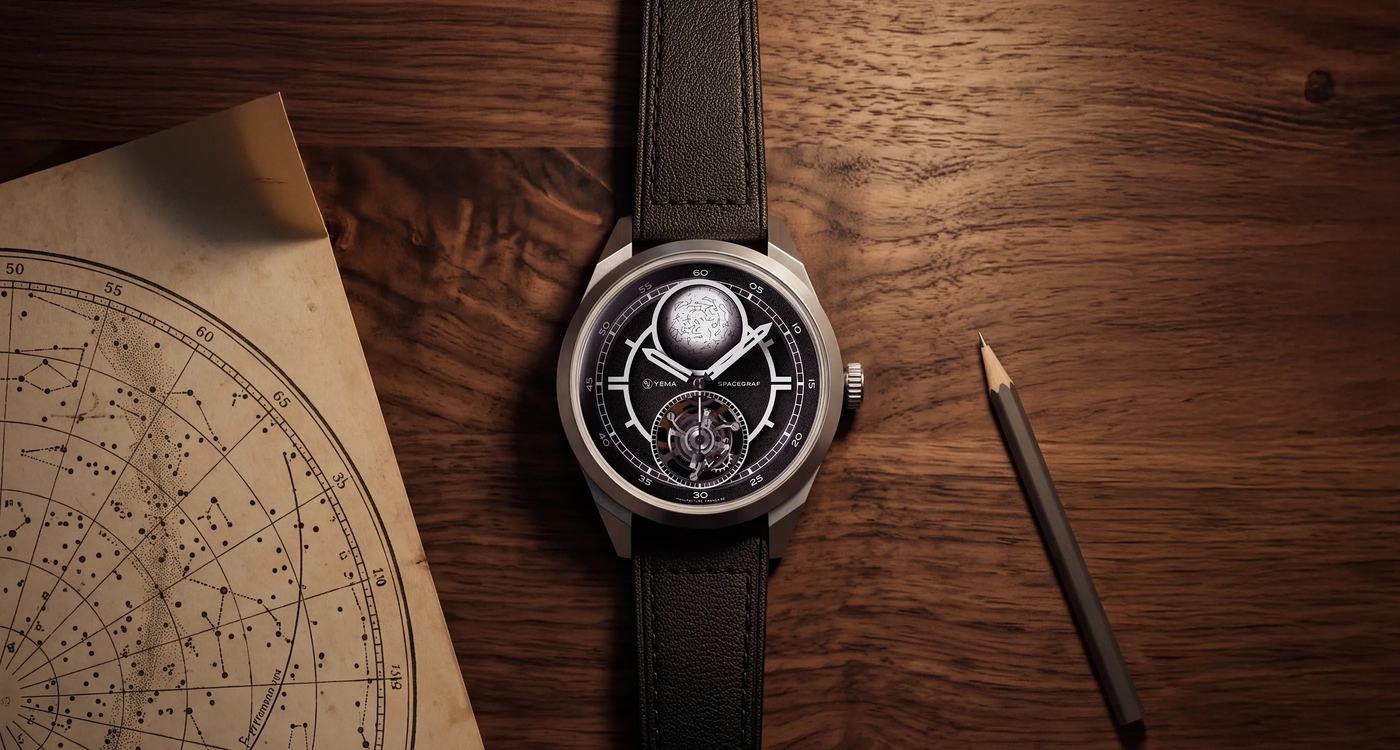
The idea behind the piece reads like a love letter to Besançon, the city where Yema was founded in 1948 and still the symbolic heart of French watchmaking. In 1878, the city built its astronomical observatory for one reason above all: so that local watchmakers could set their watches by the stars. The Spacegraf revives that founding gesture on the wrist, and it does so with a flying tourbillon turning beneath a rotating map of the heavens.
A Watch That Runs Four Minutes Late — On Purpose
The headline complication is sidereal time. Our everyday clocks follow the sun, but the stars keep a slightly different rhythm: a sidereal day lasts 23 hours, 56 minutes and 4 seconds, because the Earth’s orbit around the sun shifts the solar position against the background sky by roughly four minutes each day. Observatories have used sidereal clocks for centuries to aim their telescopes; the Spacegraf shrinks that tradition to 42 millimeters of grade 5 titanium.
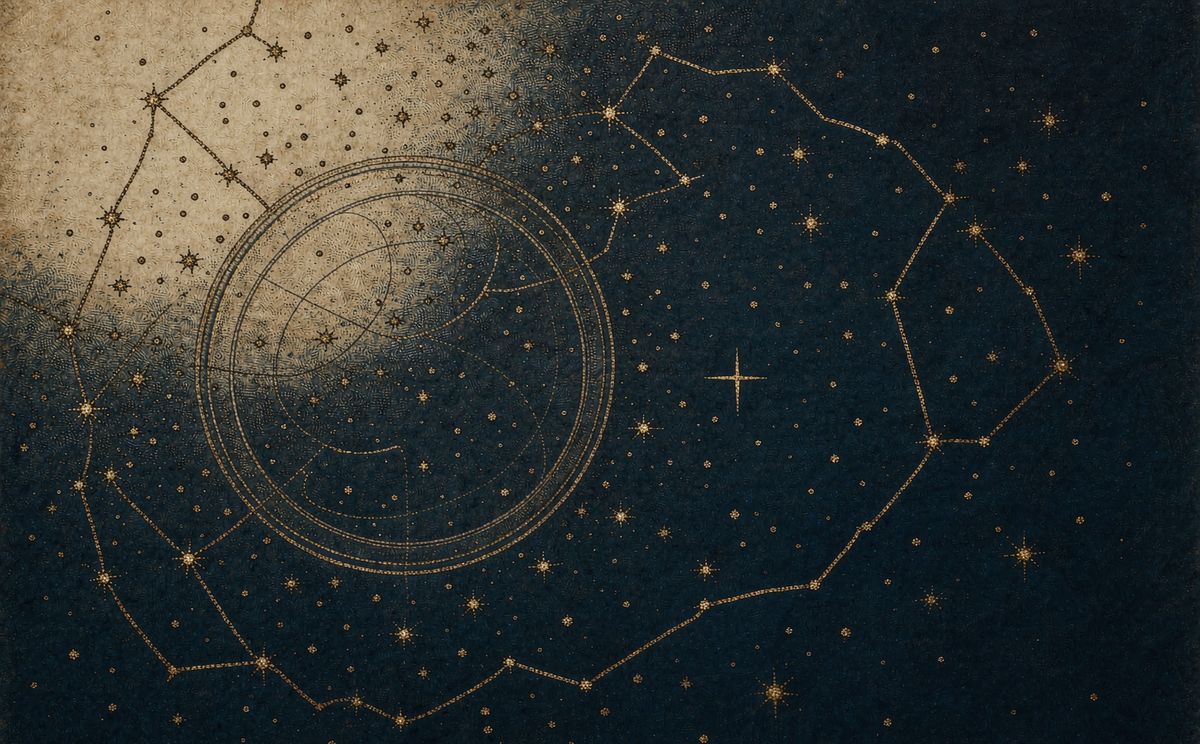
On the dial, an entire celestial disc rotates in step with the real sky, displaying at any moment the stars actually visible above you. It is a genuinely poetic complication — glance down at 9 p.m. and the disc shows you October’s sky, not some generic starfield. Yema completes the picture with a flying tourbillon at 6 o’clock, its seconds read off the rotating cage itself.
Design That Earns Its Jewels
From a styling standpoint, this is one of the more disciplined tourbillons we have seen lately. The 42mm case is just 12.15mm thick — remarkably slim for a watch carrying both a tourbillon and a rotating sky disc — with vertically brushed flanks, a circular-brushed and polished bezel, and 21mm lugs that keep the proportions elegant on the wrist. The deep black, sandblasted dial layers two chapter rings: a notched, three-dimensional ring that arcs around the tourbillon aperture, and a classic railroad-track minute scale with Arabic numerals.
That restraint is exactly what makes the watch work as an accessory. Titanium’s gunmetal neutrality pairs effortlessly with steel, white gold and platinum jewelry, and the black leather strap with matching stitching stays out of the way of a bracelet or cuff. This is a conversation piece that never shouts — the theatrics only begin after dark.
A Luminous Sky, Through and Through
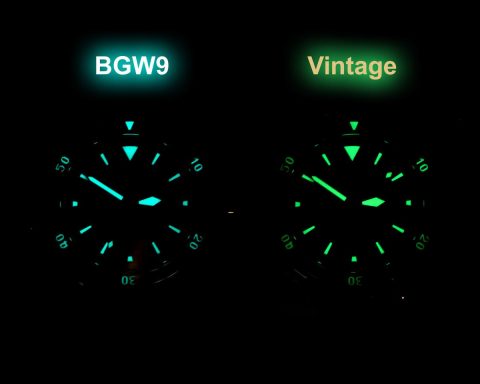
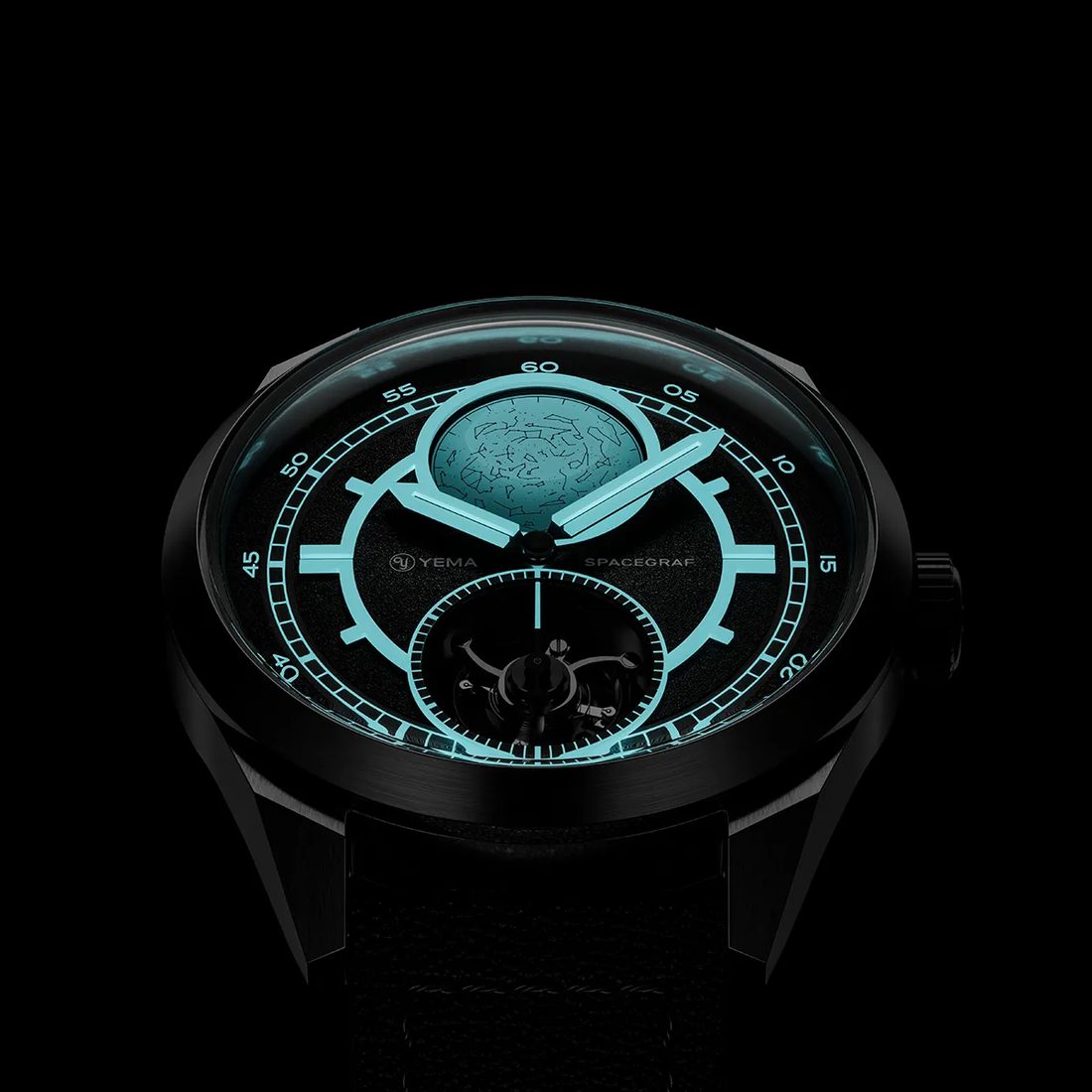
When night falls, the Spacegraf transforms. Nearly every dimension of the dial — the 3D numerals, the notched ring, the hands, even the entire celestial disc — is treated with Grade X1 Super-LumiNova BGW9, applied so that the markers glow through their full depth. The result is a star map shining on the wrist, which may be the most charming execution of lume we have seen this year.
Collector Context: The Millésime Program
The “Millésime” label marks the very best Yema can offer in a given year, and 2026’s entry arrives with serious credentials. The CMM.32 (Calibre Manufacture Morteau 32) is designed and assembled in-house at the brand’s Morteau workshops in the Jura mountains — the same manufacture that has been rebuilding Yema’s technical credibility since the Montres Ambre group acquired it in 2009. The flying tourbillon caliber delivers 105 hours of power reserve, a −3/+7 seconds-per-day rating, resistance to magnetic fields up to 2,000 gauss and shocks up to 5,000 G — specifications that would be notable in a plain three-hander, let alone a tourbillon.
History buffs will appreciate the lineage, too. Yema was the first French watch in space on Jean-Loup Chrétien’s wrist in 1982, and the Spacegraf name itself carries space-program heritage. A sky-watching tourbillon is a fitting next chapter.
How Rare Is a Sky on the Wrist?
Celestial complications have historically belonged to the grand houses: rotating star maps and planetarium dials live almost exclusively in five- and six-figure territory, from independent astronomical specialists to the most storied maisons in Geneva. That is what makes Yema’s execution noteworthy — a geared celestial disc, driven by the movement rather than hand-set and forgotten, appearing on a 150-piece edition rather than a unique piece. It brings a category of watchmaking that most collectors only encounter at auctions within genuinely aspirational-but-attainable reach.
Styling the Spacegraf
In person, the watch reads more architectural than ornamental: the gunmetal titanium case, the deep black dial and the silvered star map keep the palette cool and monochrome. That makes it unusually easy to live with for a tourbillon. Pair it with steel or white-metal jewelry, keep the rest of the wrist quiet, and let the celestial disc do the talking. On a black leather strap with matching stitching and a titanium pin buckle, it slips under a cuff at 12.15mm thick, and its 100-meter water resistance means you never have to think twice about it.
The Spacegraf Heure Sidérale Tourbillon Volant is limited to 150 individually numbered pieces, priced at €14,500 (listed at $16,000 on Yema’s international store). That is a serious sum for a brand whose core collection lives far below it, but the Millésime program is precisely about planting a flag — and few flags in this price bracket pair an in-house flying tourbillon with a complication as romantic as the real sky. For collectors who like their horology with a sense of wonder, and their jewelry box dark and cool-toned, the Spacegraf is one of the year’s most quietly charismatic debuts.