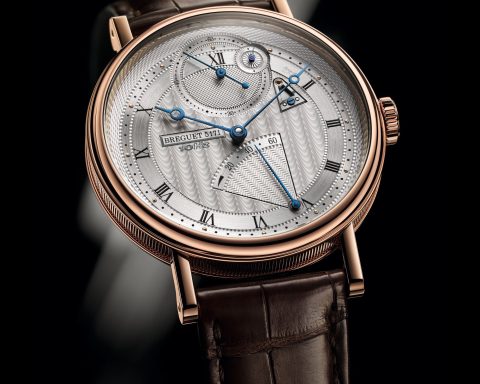
Every October in Geneva, the watch industry holds its version of an awards night. The GPHG — the Grand Prix d’Horlogerie de Genève — hands out the Aiguille d’Or, the “golden hand,” to a single watch chosen from the year’s entire output, and winning it changes a brand’s standing overnight. Last year the trophy went to the Breguet Classique Souscription 2025, a celebration of a 250-year-old giant. This year it went somewhere very different: to Rexhep Rexhepi, an independent watchmaker who builds roughly fifty watches a year in a workshop in Geneva’s old town. His Chronograph Flyback, known to collectors as the RRCHF, took the 2026 Aiguille d’Or — best in show, over every conglomerate flagship on the table.
A grail that was already a grail
Here is the collector’s reality: the RRCHF was already one of the hardest watches in the world to buy before it won anything. Rexhep Rexhepi’s entire production — every reference, every complication — runs to about fifty watches a year, all sold by allocation rather than off a shelf. His earlier Chronomètre Contemporain pieces have traded at auction for many multiples of their retail price, which tells you the queue is not getting shorter. The Aiguille d’Or does not create demand so much as confirm it: the industry’s jury has now formally agreed with the secondary market.
For everyone else, the award still matters. It is a signpost for what the next decade of collecting will treat as significant. When a jury of industry veterans crowns a hand-wound flyback chronograph over ultra-complications like a grande sonnerie, the message is that finishing, coherence and a personal voice now outrank raw complication count — a shift that has been building for years and is now official.
The color is the jewel
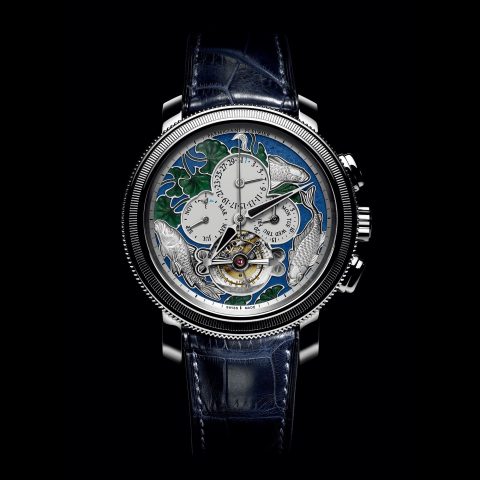
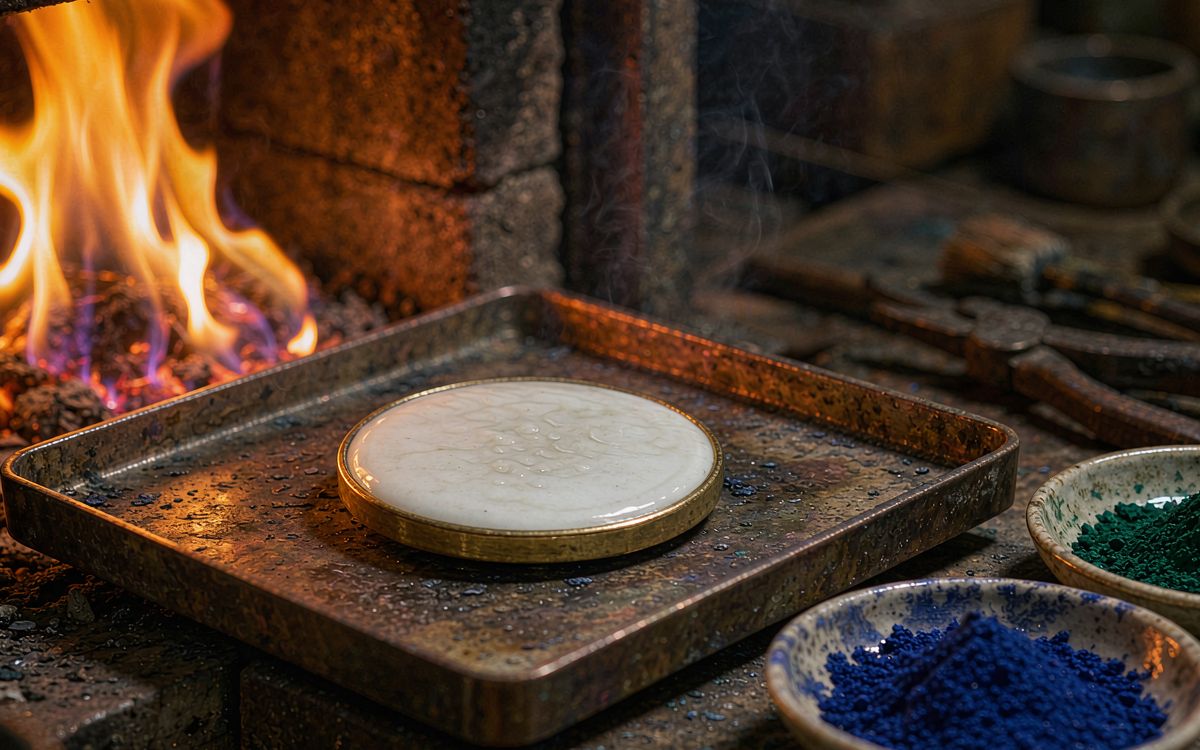
What draws the eye first is the dial, and it is worth lingering there. The platinum version wears a storm blue-green Grand Feu enamel that shifts with the light — one moment it reads like deep tourmaline, the next like the underside of a wave. Grand Feu enamel is a jewelry-house craft as much as a watchmaking one: powdered glass, kiln fire, and a maker’s willingness to lose most of what they fire. On a dial this color, the effect is closer to a fine gemstone than to paint, which is exactly why enamel-dial watches sit so naturally in collections that also hold colored stones.
The layout is just as personal. Hours and minutes sit in an off-center subdial at twelve o’clock, leaving the thin, oversized chronograph seconds hand in charge of the center. Below, the small seconds and chronograph minute counter are cut from tinted sapphire, so you are literally looking through the dial into the movement. A discreet “Horlogers à Genève” — watchmakers of Geneva — captions it all.
How a piece like this fits a collection
Collectors talk about the “icon slot” — the one watch in a box that anchors everything else. Pieces like the RRCHF are what that slot exists for: not the most wearable necessarily, not the most expensive on paper, but the one with a story that will still be told in twenty years. The specs support the romance. The case is 38.8 mm across and under ten millimeters thick, in platinum or rose gold; the movement is entirely in-house, hand-wound, with a column wheel, a horizontal clutch and 72 hours of reserve; even the nubuck strap is made and hand-stitched in the workshop, on a Norwegian central seam.
The price, where allocations are granted, is CHF 150,000 in either metal. That is serious money, but it is not the barrier — the barrier is the list, and winning the industry’s highest prize tends to make lists longer, not shorter. For most collectors the realistic play is to follow the category: independent chronographs are the segment this award just legitimized, and the wider field — from young enamel specialists to recovered historic manufactures — is where the next Aiguille d’Or contenders are quietly being finished by hand right now.